Learn More
An Introduction to Greyhounds
The Greyhound is a very old European breed of dog, a sighthound which has been historically bred for coursing game and latterly Greyhound racing. Since the rise in large scale adoption of retired racing Greyhounds, particularly in North America from the end of the 20th century, it has seen a resurgence in popularity as a family pet.
Greyhounds as pets
Greyhound owners and Team Greyhound Adoption of Ohio consider Greyhounds to be wonderful pets.
Greyhounds are quiet, gentle, and loyal to owners. They are very loving creatures, and they enjoy the company of their humans and other dogs. Whether a Greyhound enjoys the company of other small animals or cats depends on the individual dog’s personality. Greyhounds will typically chase small animals; those lacking a high ‘prey drive’ will be able to coexist happily with toy dog breeds and/or cats. Many owners describe their Greyhounds as “45 mile per hour couch potatoes”.
Greyhounds live most happily as pets in quiet environments. They do well in families with children as long as the children are taught to treat the dog properly and with politeness and appropriate respect. Greyhounds have a sensitive nature, and gentle commands work best as training methods.
Greyhounds cope well as three legged dogs.
Occasionally, a Greyhound may bark; however, Greyhounds are generally not barkers, which is beneficial in suburban environments, and they are usually as friendly to strangers as they are with their own family.
A very common misconception regarding Greyhounds is that they are hyperactive. In retired racing Greyhounds, this is usually not the case. Greyhounds can live comfortably as apartment dogs, as they do not require much space and sleep close to 18 hours per day. In fact, due to their calm temperament, Greyhounds can make better “apartment dogs” than smaller, more active breeds. Just be sure to reserve some extra space on the couch.
At most race tracks, Greyhounds are housed in crates for sleeping. Most such animals know no other way of life than to remain in a crate the majority of the day. Crate training a retired Greyhound in a home is therefore generally extremely easy.
Team Greyhound requires that owners keep their Greyhounds on a leash whenever outdoors. This is due to their prey-drive, their speed, and the assertion that Greyhounds have no road sense. In some jurisdictions, it is illegal for Greyhounds to be allowed off-lead, even in off-lead dog parks, so it is important to be familiar with the relevant local laws and regulations. However, a good run at once a week may be important, especially for younger Greyhounds, and suitable areas can usually be found. Due to their size and strength, Team Greyhound requires that fences be between 4 and 6 feet, to prevent them from jumping out.
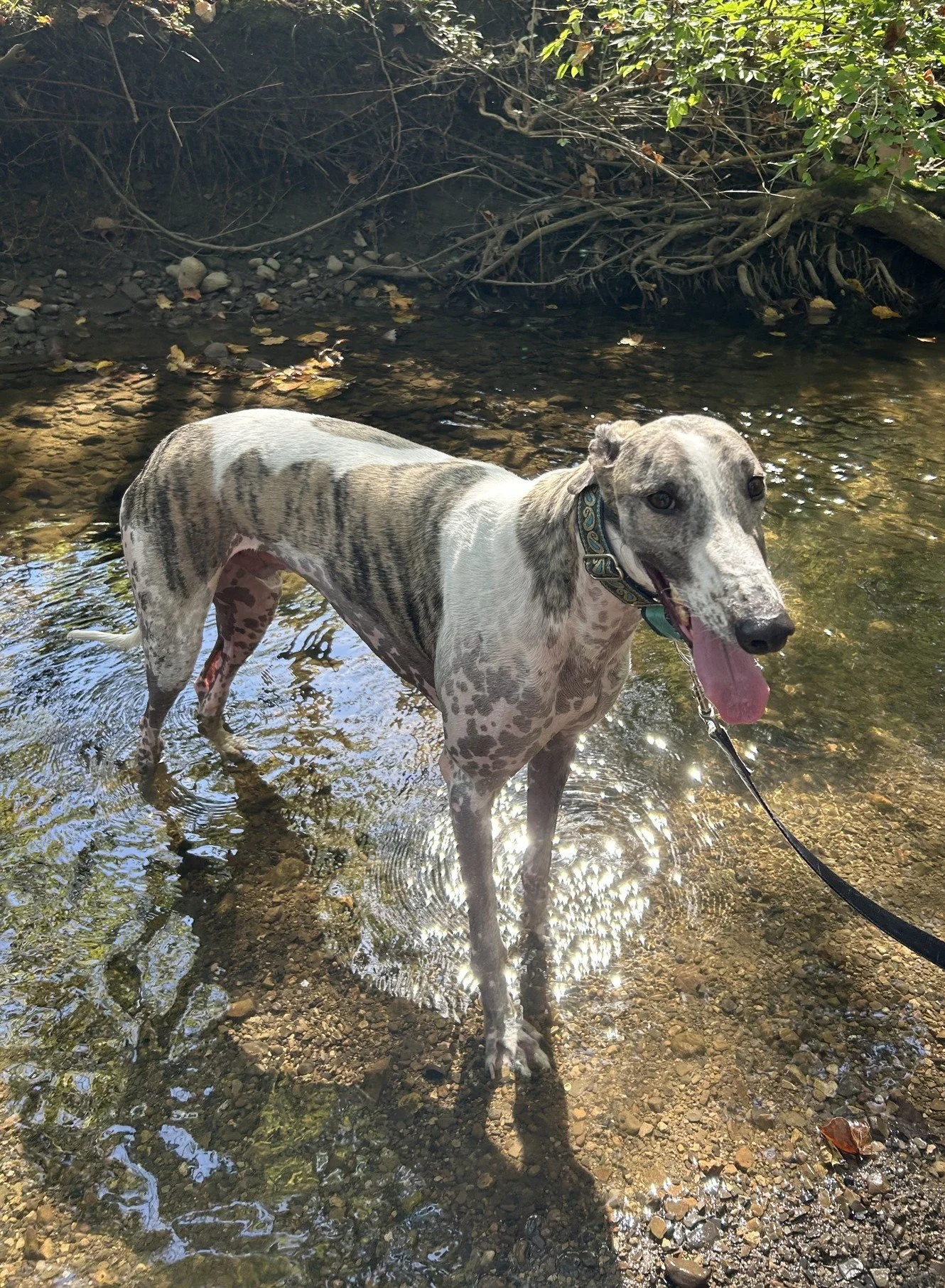
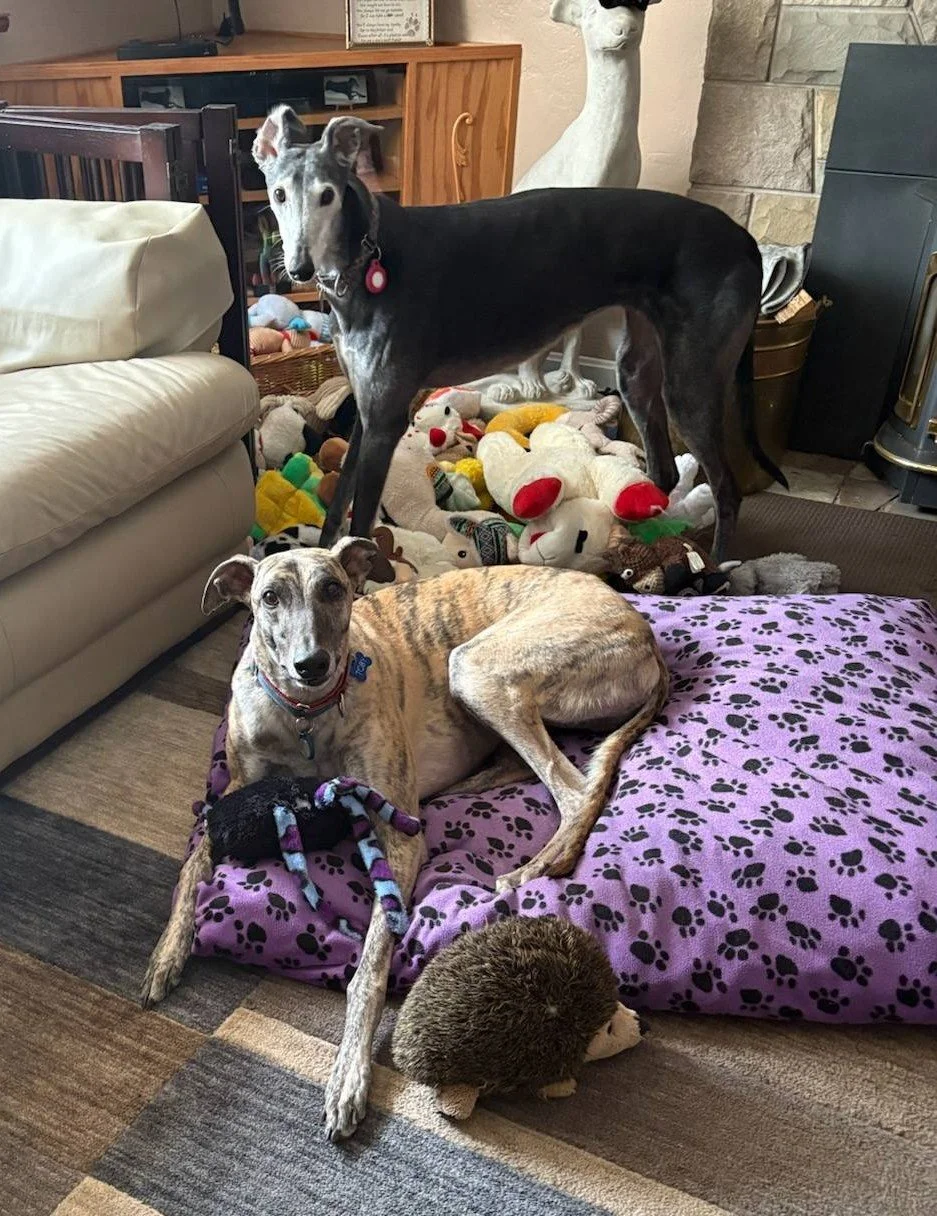
-
Adopting a Greyhound is very rewarding. The costs are reasonable and quite comparable to that of the adoption of many other breeds of dogs. You’ll become a proud owner of one of the most interesting breeds of dogs on the face of the earth.
Adoption and Fostering Process
Although you may see a picture of a beautiful dog and want to adopt or foster it, it may not be the right dog for your home. Sometimes we have multiple applications for the same dog. Please remember that all dogs are placed at the discretion of Team Greyhound. The purpose of the home visit is to introduce a greyhound to your home, family and other pets. We also check for any home related safety issues. After the home visit is completed, a recommendation is then made for adoption or foster. If approved you will be notified and depending on whether you are interested in adoption or fostering, the next steps will begin.
The length of time between receiving your application and getting a dog will depend on a variety of factors. Generally, the process takes about 2 to 3 months. Please be patient as we are all volunteers working hard in our spare time to place these dogs in a timely manner. If you want to know the status of your application, please feel free to contact your area Team Greyhound representative at any time. If no dogs are currently in your area, you may need to travel within Ohio to pick up a dog.
Adoption and Fostering RequirementsAll applicants must agree to maintain appropriate vaccinations, preventative heartworm medication, and appropriate veterinary care. In the case of fostering, Team Greyhound will provide you with the necessary medications and contact information.
All applicants must agree to keep the appropriate tags on the greyhound at all times. The Team Greyhound adoptive dog brass tag is required on all dogs and for adopted dogs you must also have the rabies, county dog license and a name tag.
All family members in the home must agree with the decision to bring a retired racing greyhound into your home.
Team Greyhound requires that all potential adopters read Adopting the Racing Greyhound by Cynthia Branigan (third edition). This is also good reading for our fostering applicants, too.
All applicants must understand that greyhounds are not outside dwelling dogs and must sign an agreement stating to never tie out the dog. The greyhound must always be kept indoors.
We require both personal and veterinary references. After the references have been approved, you will be contacted to arrange a home visit with a dog. If adopting, we will try to bring a dog of your choice or one that matches your lifestyle.
All greyhounds we place are ready to be adopted or go into a foster home. They will have been:
Spayed or neutered
Vaccinated
Tested and on preventative medicine for heartworm disease
Wormed for intestinal parasites (for rounds, hooks, whips, and tapes)
Examined for dental issues, including a cleaning if necessary
Treated and on preventative medicine for flea infection
Micro-chipped
Nails trimmed
Bathed
Our greyhounds will come with:
A martingale collar and leash
A greyhound muzzle
Food and medication (for fosters)
Although a fenced yard is not required, it is highly recommended. A fenced yard is required if you have small children two years old or under. It is the policy of Team Greyhound to not introduce greyhounds to homes with electric fencing or fences under 42”, as either of those systems are not a safe form of containment for a greyhound. The greyhound is required to be kept in an enclosed area with appropriate fencing or leash walked at all times. Leash walking a dog is a HUGE commitment. If you do not have a fenced area for the greyhound to relieve himself, then he MUST be leash walked about 4 to 5 times per day. This means that rain or shine, sleet or hail, better or worse, sickness and health, you must be out there walking that dog. Please carefully assess your ability to adhere to this before submitting an application.
To test your ability to leash walk a dog for many years to come, we recommend the following trial before applying to adopt. Determine the times that you will be taking your dog out, which will most likely be first thing in the morning, mid-morning or upon returning home from work, early evening and before bed. At those pre-determined times go stand outside and walk in small circles (as if waiting for the dog to do his business). Stay out there for at least 10 minutes. Once a day, take a nice walk for exercise. Do this every day for two weeks and don’t miss a time because your dog won’t let you! If you ARE NOT screaming UUGGHHH I CAN’T DO THIS, then you are a good candidate to adopt or foster without a fence.
-
The Greyhound is a gentle and intelligent breed whose combination of long, powerful legs, deep chest, flexible spine and slim build allows it to reach average race speeds in excess of 40 mph. The Greyhound can reach a full speed of 43 mph within six strides (about 33 yards) from the boxes, traveling at almost 45 mph for the first 270 yards of a race. There are few mammals that can accelerate faster over a short distance, such as the cheetah, which can reach speeds of 68 mph over 3-4 strides from a standing start and pronghorn with an alleged top speed of 58 mph.
-
Males are usually 28 to 30 inches tall at the withers and weigh around 60 to 88 pounds. Females tend to be smaller with shoulder heights ranging from 27 to 28 inches and weights from less than 60 to 75 pounds. Greyhounds have very short fur, which is easy to maintain. There are approximately thirty recognized color forms, of which variations of white, brindle, fawn, black, red and blue (gray) can appear uniquely or in combination. Greyhounds are dolichocephalic, with a skull which is relatively long in comparison to its breadth, and an elongated muzzle.
-
The Greyhound is not an aggressive dog, as some may believe due to muzzles worn during racing. Muzzles are worn to prevent injuries resulting from dogs nipping one another during or immediately after a race, when the ‘hare’ has disappeared out of sight and the dogs are no longer racing but still excited. The thin skin of the Greyhound can tear easily from a small nick from teeth, so even a minor skirmish can result in stitches and time out from racing. Greyhounds with a high prey drive occasionally wear muzzles outside the racetrack; owners aware that their Greyhound has a high tendency to chase small prey will protect the prey by applying the muzzle.
Contrary to popular belief, adult Greyhounds do not need extended periods of daily exercise, as they are bred for sprinting rather than endurance. Greyhound puppies that have not been taught how to utilize their energy, however, can be hyperactive and destructive if not given an outlet, and they require more experienced handlers.